Thursday, September 7, 2017

Setting Goals as Mathematicians

Before school started I created posters based on Tracy Zager's book Becoming the Math Teacher You Wish You'd Had.  Here is a link to the posters.  I decided I wanted to draw my students attention to these posters.  So on day 2 of class asked my students to read the posters and answer these questions.


  • What stands out to you the most? Why?
    • I was curious as to what they would say.  I love everything about these posters, but maybe something in particular would resonate with a student.  
  • Give an example of something on the posters that you have done.
    • I wanted them to start to realize that they are already mathematicians and they already do many if not all of these things.  
  • Pick one of the things on the posters that you would like to work on this year
    • Typically when students are asked to create goals they say they want to get As, work hard, or study more. Having these characteristics defined should make it easier for us to monitor and track this goal.
This activity took about 5 minutes and here is what I learned:


As much as we talk growth mindset and learning through mistakes this is not the message these students are hearing. (I blogged about this a little while ago.) I need to work to create a classroom where value is placed on the process and not the answers. And in 7th grade I think it is going to have to be extreme in order to offset the effect that letter grades (their first time getting them) will have on their perspective.


Showing work and explaining thinking is seen as busy work.  "If I have the right answer why do I have explain it?" If the students are just working independently to find a solution that will not be discussed or have talked something out with a group sharing their explanations verbally, then it possible that showing work is busy work.  I am going to have to go back to Tracy's book again.  The chapter on reasoning and proving really helped me to see the mathematician view of these and I want to be sure to share that perspective with my students.  


How true is this one? My daughter starting talking to me about text to self connections in first grade.  Then I learned about text to text and text to world (she is a little teacher and likes to make sure I know my reading skills).  Seriously, let's start bringing this to math. I think an exit slip might be where I start with this one.


Yea! I am excited to have discussions about these this year.  This is why I loved Tracy's book so much.  There are key parts of being a mathematician that we need more of in the math classroom.  We need to trust and doubt ourselves.  Don't assume your answer is right (or for those lacking confidence, wrong).  Finding a solution is not an end to the problem.  There is still so much work to be done.  I absolutely love that students noticed and questioned these aspects of being a mathematician.


As for our goal setting, the top 2 responses for what students want to work on were taking risks and asking questions.  I think this example shows that for many those two go hand in hand.  I plan to use this as a launching point next week for creating some class norms that will help ensure we have an environment where students feel safe asking questions and taking risks.  I'll keep you posted.


If you are interested in my other  Becoming the Math Teacher You Wish You'd Had blog posts you can find a complete list here.

Thursday, August 31, 2017

Mathematicians...

Have you read Tracy Zager's book Becoming the Math Teacher You Wish You'd Had?
If not you definitely should.  After reading it this summer I created these posters for my room.  It is the key points from each chapter written in student friendly language.  My plan at this point is to hang them up.  That's really all I have at this point.  It's good to keep the bar low so I can actually follow through with this goal. 😜  I hope to refer to them throughout the year as it fits with conversations we have in class.  I will continually add to this blog as I do so that I can reflect on how to use these posters effectively in the future.  If you use them I would love to hear about it in the comment section.


UPDATE: I asked the students a few questions about what was on the posters.  I wrote about it here


If you are interested in my other  Becoming the Math Teacher You Wish You'd Had blog posts you can find a complete list here.

Wednesday, August 9, 2017

Finding Fun


As I continue to work my way through start of the school year reflections, I have blogged about my anxiety as a teacher and as a parent.  Now it is time for a little fun.

Fun? What is that?
Oh, fun is something you used to know.  It must feel like a distant memory.
I don't think we have time for that. There is too much to do.

I'm not sure at what age the shift happens, but by seventh grade I can tell you there is little time for fun.  It has literally been taken out of the schedule.  My school now has 20 minutes once a week for what we call homeroom, a scheduled time to connect with students and help them connect with each other,  oh and also cover topics like drugs, alcohol, bullying, character values, etc. Woo hoo, fun.  
The way I see it I have 2 options.  I can give in to this fun-sucking schedule and become one of those stressed out teachers that always looks cranky with the weight of the world on their shoulders as I wait for systemic change, or I can take charge of that which I can control: my classroom.

Now don't get me wrong.  I am extremely passionate about math and we have fun with it every day.  I think that my enjoyment and wonder of math rubs off on my students.  But I want more than that.  I want non-curricular fun.  The inside jokes that bond us together as a class.  The memories that will be written in yearbooks.  The nostalgic moments that we will look back on fondly.  

The challenge as a middle school teacher is that most of my students find most of their humor at other people's expense.  The sarcasm and mocking stems from the fact that middle school students have such low self confidence and are trying to find their place.  Every. Single. One.  Don't be fooled by confident middle school students.  They put on a good show, but every joke cuts deep and is internalized in ways that will impact who they become.  

This is why finding fun is so important.  But those stressed out teachers are right, there isn't time, at least not much.  The key to daily classroom fun is it must be simple (or you can't keep up with it) and it must be authentic.  Each teacher has to find their own style.  You can't fake fun or follow someone else's lesson plan for it.  So ask yourself: what do you find fun? 

I start each lesson with a math cartoon or funny gif.
My brother and I enjoy debating foolish things, usually food.  It drives my husband crazy, but my students love it. It often comes up when we are doing Estimation 180 tasks because they involve food.  Candy corn or pumpkins? Tough call.  Red Vines or Twizzlers? Redvines, obviously.

I never wear plain socks. In February, when there are no holiday breaks in sight, I start up fun sock Fridays.  The kids love showing me their fun socks.
Of course music is another great way to lighten the mood.  Since we are talking socks, here is a good one (the music starts about 30 seconds in):

 And then there is the foolishness that was the welcome to this blog.  Like many teachers I use bitmojis as if they are my team teacher.  Biti me is everywhere.  I was out of class an unusual amount last year and when I was planning for a sub, yet again, I got the brilliant idea that I would make Biti me talk.  It would be just like I was there (FYI it was nothing like I was there.  The students found it creepy and funny at the same time.)  So for those of you wanting to do the same, here is how it is done.

The Bitmoji must be saved as a picture on the iPad to access it from Chatterpix.  I do not have Bitmoji on my iPad, but I do have a folder in Google Drive with my favorite and most used Bitmojis saved as pictures.  I can then open drive on the iPad and download the Bitmoji pics to the iPad.  I also have Bitmoji in my email and can email them to myself and open them on the iPad.

In Chatterpix, select take a picture and you can choose the Bitmoji from your camera roll.  Chatterpix is very intuitive and user friendly.  You select where you want the mouth to open by drawing a line and record your voice.  Once you have created a talking Bitmoji, download it back to the camera roll.

From the iPad you can either upload it back to Drive or upload it to YouTube.  That way you can access it from a computer.  I chose to upload to YouTube and insert it in a Google Presentation.  Now that you can insert videos from Drive either option would work well.
A few tips:

When I was on my iPad, I remembered this fun (and free) app called Sock Puppets.  I forgot how much fun it is and might have to add it to the mix this year. 

#truestory
I don't care what grade you are in.  That is just fun, right?  

Like I said, it has to be simple and authentic.  If these ideas don't sound fun to you, don't use them.  Kids can smell contrived fun and won't buy into it.  I would love to hear what you do to add fun and memories to your classroom.  Please use the comment section below to let me know!


Monday, August 7, 2017

Keeping Parents in Mind

It is here!  It is finally here!  My baby will be going into kindergarten this year!
(In case you are not familiar with the Brian Gordon's work, he has chronicled the life of every parent in his comic.  If you are a parent you need his books.)

This year all three of my children will be in elementary school. (The same school with just one drop off point.  No big deal, I have just been waiting 5 years for this.)  As much excitement as I have for this school year, I have the same amount of anxiety.  Let me explain.
My daughter is going into third grade.  She has struggled with anxiety and perfectionism.  Her inability to focus compounds it.
My son is going into first grade and academically he is above grade level in most areas.  It took him all of kindergarten, however, to make one friend who will now be in a different class.
And then there is my baby.  He had an IEP for speech because he was unable to get words from his brain to come out his mouth. He does talk now, but I still see him know something once and never again.  He is impulsive and everything is a game.  He is extremely determined and my husband and I are still waiting to see if he will use his powers for good or evil.

Pernille Ripp, in her keynote at SITA, spoke about her daughter that was born prematurely.  They spent the first few years of her life waiting to see if there were any issues with her brain development.  She spoke about how important it is for us, as parents, to share these stories with the teachers.  How will teachers know if we don't tell them?  I will definitely be following this advice, but with hesitation.  How much do I tell?  When is the appropriate time to share?  How will I come across to the teacher when I share this information? Too involved? Not trusting the teacher's abilities? Caring parent (I hope)?  

This tweet is a good reminder to teachers to keep the parents in mind. As a teacher, I don't want any of my students' parents to hesitate or not reach out to share their thoughts, worries, concerns, etc. Last year I came across this article in Education World.  It is a simple invitation to parents and gives them an opening to share whatever is on their mind with the start of the school year. I decided to try it.  

Here is the email I sent home to parents:

The first few weeks of school are full of activities that allow teachers and students to get to know each other.  As the month goes on I will start to understand your child as a learner, identifying strengths, weaknesses, learning styles, etc.  I would like to tap into the greatest resource available to me, you.  You know your child better than anyone (including them).  So, if it doesn't add too much stress to your life, I would like to give you a bit of a homework assignment.  I would like you to tell me about your child in a million words or less.  You can share anything you want with me.  I will share important information with the other VIP teachers (ELA, science/social studies) unless you specifically ask me not to.  It can be as long or as short as you want. 
  • You can email it to me.  
  • You can write it on paper and send it to school with your child.  
  • There isn't really a due date, but in case you are like me and put things off until the last minute, try to get it to me by Sept. 15.

I want to thank you in advance for your support.  I think this will really help me understand my students, so I can best support them and help them to feel connected at DPMS.

The response I got was amazing.

Many parents wrote back.  Some wrote a few sentences, others a couple pages.  It gave me a much clearer picture of each student.  (FYI: I did have a student who was born prematurely.)  What I loved about the responses was that I was able to see the child through the parents' eyes.  They see the strengths, the flaws, the consistent struggles year after year, the new struggles, and it is all shared with so much love.  I printed the responses and I would read through them again from time to time throughout the school year.  When I was so wrapped up in a student's behavior issues, I could read the note and be reminded of the person that is within.  I had a student share issues she was having with her parents and feeling like they didn't care.  I pulled out the letter her dad wrote at the beginning of the year so she could feel the love that seemed to have gotten lost in day to day living. I will definitely be sending this message again this year.  My goal is to remember to send it when new students come throughout the year.  

Even if they don't respond, sending this invitation to parents accomplishes what John Steven's tweet encourages.  Parents know they are my partners in education and that I care about their children. 

Sunday, August 6, 2017

Forever Caught in the Space Between

It is August and therefore time for me to turn all of the great summer professional development ideas into reality in my classroom.  I am energized, excited, and overwhelmed all at the same time.  This will be my 5th year back in a math classroom (I use the word back because I had an 8 year "break" from it while I taught Computer Literacy).  I was introduced to #MTBoS about a year and a half ago and it exploded my teaching and life in the most wonderful way.  My professional development this summer has consisted of a 3 day training with the Enhanced Learning Maps project, rereading books from the US Math Recovery Council, SITA (a local educational technology conference), Summer Spark, Building Math Minds Virtual Summit, and an online book study of Becoming the Math Teacher You Wish You'd Had.  It sounds like a lot now that I am writing it, but since returning to the math classroom I feel like there is so much I want to learn about development of math learning and effective teaching.

Part of why I took on so much this summer is because I struggled last school year.  I am a good teacher.  I can make this claim because I was recognized this past year by the Greater Green Bay Chamber Partners in Education with a Golden Apple Award.  I realize you most likely do not know what this award is, but where I live it is an honor.  Even though I am a good teacher, I struggled.  When I look back on past years of teaching (especially those first few) there is so much I would differently now that I know better.  That is the point of all this professional development, isn't it? To do better.  There is one student in particular that I see around town.  I worked with him one on one with an intervention program we were piloting.  He and I both struggled for a semester and then our time together was over.  The following year I started working with the US Math Recovery Council and now have a much better understanding of the help this student needed.  Unfortunately he had moved on to high school and I am left with regrets.  I am sure you can relate.  That is why there are so many posters like this:

This is actually the quote that I referenced when talking to a colleague last year.  My biggest struggle is that with all of this great professional development and wonderful supportive community on Twitter, I now know better.  A lot better.  The problem is I am struggling to do better.  Since I know many people are reading the book I am going to use Becoming the Math Teacher You Wish You'd Had as an example.  If you haven't read it yet, you should.  It is amazing.  It is a comprehensive labor of love in which Tracy Zager has pulled together research, mathematician viewpoints, and classroom examples of everything those of us who love mathematics want for each of our students.  You can feel the love and passion when you read it.  It is everything I want for my classroom.  I want to be the teachers in this book.  I guess that is kind of the point.  It is the name of the book.  As I reflect on all that I learned in the book, these questions come to mind:

  • Where do I start?
  • How will I remember all that I want to do once the school year gets going?
  • Last year as I improved some areas, others that I had been doing well fell away.  How do I prevent this from happening again?
  • Do the math teachers in this book see themselves as the math teacher they wish they had?
  • Does every day in their class look this good?
  • Do other teachers feel as behind as I do?
  • How long will it take me to become this math teacher that see in my head?
  • Will I ever get there?
I can already tell you the answer to the last one.  It is no.  I will always be growing as a math teacher.  I will be better than those first few years, but I will always be learning new things and gaining new perspective.  In terms of Tracy's book, I will always be becoming that teacher.  I won't be the math teacher I had, and I won't be the math teacher in my head.  I will forever be caught in the space between.  I wonder if it was a purposeful word choice by Tracy.  Becoming (noun) process of change, as opposed to become (verb) to change or grow to be.


The reflection for me, and anyone else who is reading this, is to remember that this is a process.  There are many things I want to try/implement/create/do in my classroom this school year.  It is ok if I don't get to all of them.  It is ok if they don't go well.  I cannot solve all of the problems in one school year.  I need to have the same patience with myself as I do with my students.  There is no such thing as perfection. I can't compare myself to other teachers. I need to do what works for me and feels right in my classroom. We are each taking our own journey.   
With all of that in mind, I am ready to start another school year, reflecting on what I want to do differently, but at the same time acknowledging the great teacher I already am.


UPDATE: I have been moving a little closer to the teacher I want to be. 
If you are interested in my other  Becoming the Math Teacher You Wish You'd Had blog posts you can find a complete list here.

Sunday, May 14, 2017

A Visual Representation of Square Roots

I have been working on Pythagorean Theorem, square roots, and irrational numbers with my students.  I went to my usual favorite resources and came across this representation on Andrew Stadel's Estimation 180 website in the Clothesline Math Section.  There are a couple pages of them for the clothesline. (If you are not familiar with clothesline math, it is time you get acquainted.)
Feeling both excited (because I love exploring conceptual understanding and visual representations) and confused (because I wasn't entirely sure what I was looking at), I knew I had to use these in class. I did not end up doing the clothesline activity.  What I did instead was start by showing my students a perfect square picture.  
We have used squares to discuss exponents, so my students quickly saw that this represents the square root of nine.  Square root is the inverse of squaring, therefore if you take the square root of 9 you get the side length of the square, which is 3.  After showing the perfect square picture I put up this one:
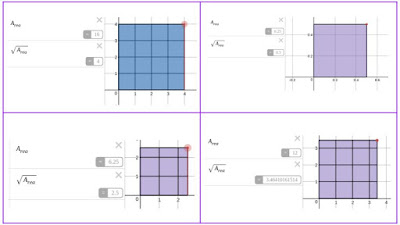
I simply asked, "If the last one was the square root of nine, what number is this the square root of?"  Every student had estimated a decimal number (Why wouldn't they? It sure looks like it won't be a whole number.)  Then I told them it was a whole number.  There were surprised and now were in the same place I was with this representation. We all needed to explore what was happening.  I told them it was 12 and let them discuss and process this information with their teams.  In the past, for numbers like the square root of 12, I would use an open square and put the answer, ~3.464, on the side of the square.  The difference with this visual is that the square is divided into unit squares. 
  • The small rectangular pieces are ~0.464 x 1 
  • The tiny square is ~0.464 x ~0.464
  • All the pieces added together equals 12.
Can we please take a minute to appreciate that?  Earlier in the school year we explored repeating decimals.  I still find it mind boggling.  1/3 is so simple to draw, yet as a decimal it repeats forever.  1/3 is a finite piece of a granola bar, but as a decimal it never ends. If you have never explored sharing that granola bar with 3 people by dividing the bar only into tenths you really should.  It will give you a whole new understanding of our base ten system and why some fractions become repeating decimals.  That exploration earlier in the year helped us understand how a decimal that does not end can so simply be represented by a small part of a square.  It is still just as mind boggling to think that those decimals which do not repeat and cannot be written as fractions, can add together to get a whole number.  And yet it does.  And that is the point of showing this visual to your students.  My depth of understanding square roots and irrational numbers increased when I analyzed this visual.  That is what I want for my students.
Students don't need to be able to look at a square like the one above and know what whole number it represents.  The purpose of the visual for the clothesline is for students to understand the relative size compared to the perfect squares and where they would fall on a number line. I will probably do the clothesline activity yet this year.

After our class discussion, I was tweeting the highlights from my week and the visual of the square root of 12 was one of them.  
There was a lot of activity on that tweet and one of them was this:

Followed by this one:


First, let me say I love my PLN.  This is why I am a part of #MTBoS.  This misconception had never occurred to me and I definitely want to go back to class and check in.  All of the squares on Andrew's clothesline are either perfect squares or irrational, which is just fine for that activity.  It is important, however, in our class discussions to have some examples with partial squares that are not irrational.  Luckily, Andrew made a Desmos activity to go along with the clothesline activity so I was able to easily create this one for the square root of 6.25. The rectangle pieces are 0.5 x 1 and the small square is 0.5 x 0.5.

To help facilitate these conversations, should you choose to have them (and for myself in the future), I put together a few starting points using some of my favorite conversation starters.  

If there are partial squares it is [always, sometimes, never] an irrational number.

I took one slide of Andrew's Desmos activity and made it its own activity so students can explore this and decide for themselves.  Students can see the area and square roots in the activity, which will help them analyze and decide.  

Notice/Wonder

You could also start with the visual representation in Desmos and simply ask, "What do you notice? What do you wonder?"  I recently discovered (thanks to Sara VanDerWerf) if you tell them to, "notice until I tell you to stop", you will have more (often better) launching points for class discussions.  You would want to modify the Desmos activity to not have the always, sometimes, never question with it.  

Which One Doesn't Belong

Take a minute to play it yourself before you read my notes.  These pictures were created in Andrew's Desmos activity and could easily be changed if you wanted something different.  Only one of them is an irrational number.  Can you tell which one? I also decided to add one where the square root is bigger than the area.  Wait, what?! How does that even happen?  There are so many possible discussions that could come out of this WODB I am gitty with excitement.  

I realize that there is a lot to take in here, especially if it is the first time you are seeing this visual representation.  Please feel free to leave comments below.  I would love to hear about your thoughts, questions, or any class discussions you have with this visual representation of squares and square roots.  


Thursday, May 11, 2017

My recommendation for parents who want to help their children improve their math skills:

As summer approaches I have been thinking about helping students maintain their math learning and how to best help support parents as they take over the role of math teacher for their child during the long break from school.  The challenge for me as a middle school math teacher is that the students are already counting down to when they get a break from school work.  How can I motivate students to want to continue their math journey through the summer months? More importantly, how can I convince parents that this can be done without the constant struggle and agonizing arguments that may have occurred during the school year?

The answer lies in a quote from Sara Vanderwerf. "What do mathematicians do? They notice patterns. They describe patterns; and they generalize patterns."

As parents, if we spend time with our children noticing the world around us, we can strengthen their math sense, and it will help in every area of mathematics.  Here is an example of what I am referring to.  The picture below is from a 7th grade assessment focusing on simple interest.

I don't want to go into a lesson on calculating simple interest, which the student was able to do (but with a 0.6% interest rate instead of 6%).  What I want to point out is the answer to the second question.  Do you know why the student multiplied 2,400 by 5?  
This is an example of what Graham Fletcher calls "Number Plucking".  I'm not sure if he coined the term, but he used it in a presentation at a conference I recently attended.  The term refers to students who take numbers from the problem and perform an operation (like multiplication) without first making sense of the information.  Graham pointed out that in lower elementary students have a 50% chance of getting it right because they are only working with addition and subtraction.  When we add multiplication and division children will be correct 25% of the time.  What does this mean for middle school and a simple interest problem like above? 

While math facts and operations are an important part your child's math learning in school, the best thing parents can do is help them to understand number relationships, patterns, and making sense of the math in the world around them.  

My Recommendation

If all of this is hitting home with you and you are wondering where you would even begin to help your child in this way, here is my recommendation. Each week I receive a newsletter from a website called Table Talk Math.  Jason Stevens, the creator of this site, is dedicated to helping parents build this sort of math thinking with their children. The free weekly newsletter has different conversation starters you can have around the dinner table (hence the name "Table Talk Math"), in the car, or wherever your summer takes you.  In addition to the website, there is a Table Talk Math book available.  

I was so excited about the ideas and potential conversations this book offers I wrote this review. 

This book is a must buy for every parent. It teaches parents how to weave math conversations into the activities we are already doing as well as provide resources and websites if I want to know more. The focus of the book is on building number sense and mathematical thinking as opposed to specific concepts so it is applicable to all age ranges and the author, Jason Stevens, explains how the different conversations can be changed depending on the age range of the child. I can see myself rereading this book every spring thinking about my children’s current skills and interests.

I found this book through following the Table Talk Math website and receiving the newsletters. It suggests great topics of conversation to have with kids based on everyday things. With summer coming up, I want to support my children’s learning and help maintain their skills. In the past I have purchased workbooks with every intention of having my kids do a few pages a day. Unfortunately this never lasts long as our summer schedule gets busy (or perhaps more relaxed) and the workbooks just collect dust. Since I was enjoying the Table Talk Math newsletters, I bought this book hoping it would give me more examples of math we could talk about over the summer. It does that and so much more.

My favorite part of the book is at the end of each chapter, there are specific tips for how to talk to my child about math. Stevens shares ways to encourage your child and how to keep the conversation positive. (Trust me there have been many not so pleasant times together during the school year trying to work on homework together.)

The Table Talk Math book is easy to read and understandable for parents, no matter what your math comfort level is. I felt like I was having my own personal conversation with the author as he shared his experiences as a child, parent, and math teacher. Plus, I really can have conversations with the author as he is very accessible on Twitter and includes a hashtag for the book to continue the conversation online.

I encourage you to check out Table Talk Math.  I would love to hear about your math conversations and experiences in the comment section below.  You can also add questions you have and I will help you in any way I can.