Tuesday, May 1, 2018

An Abstract Understanding of Concrete Things

Recently Kyle Pearce blogged about concreteness fading.  It got me thinking about a session at the Math Recovery Council annual conference with Dr. Robert Wright on the topic of settings and distancing the setting.  I am constantly reflecting on the best ways to move my students forward in their math thinking and it seems to me that this is an area in which I need to be more purposeful.  I decided to read a little more, ask a few more questions, and this blog is my reflection on all that I am thinking and learning about these topics, focusing more specifically on the role of manipulatives in my classroom.

The concept of concreteness fading as described both in Kyle Pearce's blog and in this article by the Learning Scientists is about the progression of moving students from concrete to representational to abstract.  The idea of this makes sense to me.  I feel that too often I introduce a manipulative, like integer tiles, for example, only to take it away too soon.  I allow the students to use them, but if it isn't specifically in the directions many students struggle through without them thinking they should be able to work abstractly.  This is where many kids will latch on to rules and memorization in order to work abstractly with something they don't fully understand.

What stood out to me in Kyle's blog was this quote, "We must understand that concrete manipulatives are still more abstract than using the actual items in the quantity being measured."  Just the other day I was working with a student and using cubes to represent something.  It made perfect sense to me and I realized as we were working that this student did not connect the cube with the item from the problem.  I need to keep in mind that it is not just a 3 part continuum from concrete to abstract, but there is a continuum within the concrete category.  There is so much to be purposeful and thoughtful about when selecting manipulatives and concrete examples.  I don't think I do enough to modify and adapt the manipulative choice if a student is not able to connect with it.  Plus Kyle's blog really helped me think about choosing manipulatives with the end result in mind.  Where do I want the students and what manipulative/tools get them there?  Perhaps it will be different if I am focused on adding mixed numbers with a distributive strategy versus a fraction great than one strategy.  I love the vertical number line for proportional relationships that Kyle shows to then connect to the table that shows the numbers vertically.  It's a simple change that makes a big difference! (It was both an aha moment and a face slap when I saw it. How did I not think of this?)

I also started to think about this process in reverse.  By 7th grade, many of my students have memorized rules or tricks and can solve problems abstractly.  The issue is that they lack the depth of understanding.  They can work abstractly but don't understand the number relationships enough to show what is happening concretely.  They are unable to mathematically justify what they are doing and it affects their ability to transfer their understanding to new problems.  This video of Ruth Beatty (that Mark Chubb shared with me) speaks to this.


In the constructivism definition that is given in the video, the word concrete is being applied to the students understanding.  It is not just about the concrete example or having something concrete to manipulate.  This video changed my thinking about the goal I am trying to reach with students.   I need to reverse the concrete to abstract model and work with what my students already know to help them understand more concretely.  Sometimes as a middle school teacher it can feel like I have to start from the beginning with these concepts, but I need to keep in mind that the starting point for my students is their abstract understanding.  

So how does this model of concreteness fading compare with what I know about distancing settings?  This paragraph is taken from the book Teaching Number in the Classroom.  Distancing the setting is part of progressive mathematization (which is the progression of learning and thinking in terms of mathematical sophistication).  


I am not sure if there really is a difference between concreteness fading and distancing the setting, however, the definition laid out here seems to include more.  When planning a setting, it isn't just thinking about the concrete representation, but it's selecting what verbal language and number range are appropriate, deciding how to move students through the concrete section of the continuum while interweaving the representational and abstract.  I know I have talked about concreteness fading as a continuum, but it is also cyclical so students are not just moving from concrete to abstract and done.  After giving it much thought I feel that distancing the setting is something that is done within concreteness fading.  There is one student who comes to mind with all of this.  We have worked to build strategies and his multiplicative reasoning and yet unless directed his default is to count on his fingers.  It is by purposefully distancing the setting that I can help him progress to naturally select more sophisticated strategies and thinking. 

In thinking about the examples Kyle laid out, I feel that those are the first steps in lesson planning.  I need to map out the models and progression through them.  Once that is done I need to be thinking about how to distance the setting.  Screening and flashing are great strategies.  Showing students the concrete and then covering it/part of it or showing it only for a brief moment.  This will challenge students to start creating that mental picture.  They don't have to create a mental picture themselves yet.  It is given to them, then covered, and they continue the problem with that picture in their head.  

Since I feel that distancing the setting is something that fits inside of concreteness fading, I wanted to go to Kyle's middle school example in his blog and consider ways to distance the setting as I move students from concrete to representational.  

The original picture prompt is really a screened image.  I can see part of the problem but 4 of the boxes are not pictured.  
My thoughts about distancing the setting for this example are all over the place and I have typed and retyped many times.  So many options and thoughts running through my head.  I am going to try bullet points:
  • For some students, this number range will be too high.  They will need enough cubes for all 7 boxes.   
  • Some students may need boxes to put the cubes in.  Connecting them together may not be concrete enough.
    • If a student has boxes and cubes inside of them (or cheerios to look like donuts), one way to distance the setting is to have cubes in the box and then close the box.  This could also be recreated by using cardstock that covers the cubes, acting as a box. (which I would totally print the donut logo onto)
    • Closed boxes could be added, one at a time for students who need to think additively and the through discussion and activity we could get to some multiplicative reasoning. 
    • Using boxes that show the outer donut (one row and one column) would be a way to distance the setting to help students use additive or multiplicative reasoning over counting strategies.
  • As we move to the number line in Kyle's visual example, I am loving this number line picture from Sara VanDerWerf's NCTM presentation.  I am now thinking about how to add donut visuals to the number line and table to help students connect the concrete ideas to the representations.

There is a lot to think about with just this one example.  It is a little overwhelming to think about doing this every day in my classroom.  I think, however, that once I get into the habit of thinking about these things (and dedicating time to think and reflect on it)  the ideas will flow and I will see how ideas for one concept transfers to other concepts.  It will be a progression and continual goal in my teaching.  The main questions floating through my head right now are this:

  • Do I really offer my students enough strategies to understand concretely?  
  • Is my teaching limited by my limited knowledge of "tools"?  
  • How do I build my concrete understanding so I can help my students?


Thursday, April 5, 2018

Fraction Division

I tried some new things with fraction division this year.  I want to document for it myself as well as those who ask me about it. 

I started this unit by making claims.  I wrote about that in this blog post
For the fraction division I used Cuisenaire rods:

Each student has a set of each of the 10 different rods.  Students were instructed not to shout out answers, but to set the “answer” rods aside and keep quiet so everyone has think time.  Allow time for students to figure out each task.  Ask for students to answer and ask several students how they know.

  • Orange:  “This is 1. Find ½.”  
  • Dark Green:  “This is ⅔. Find 1.”  
  • Purple:  “This is ⅖. Find ⅗.”
  • Brown: “This is ⅘. Find ⅗.”  

To explore reciprocal relationships that are needed for division:

Held up and showed students the red rod.  
  • “Now think back to the red. Let’s pretend it’s a granola bar. This is ⅓ of a granola bar. Find 1 whole.”  “How many times does ⅓ of a granola bar fit into 1 granola bar?”  “What equation can you write to describe this situation?”  Students may come up with several that are correct but ask for a division equation if they are not getting it. 
  • Purple: “This is ⅖ of a granola bar.” Find 1 whole.” How many times does ⅖ of a bar fit into the whole bar?”  
When we divided with the Cuisenaire rods it looked something like this:
I have tried to divide using number lines before and it was a hot mess.  Using the rods we were able to understand division as division (as opposed to multiplying by the reciprocal) and used a measurement model for fractions.  

I also pulled some questions out of my Developing Fraction Knowledge Book.  I love this book and highly recommend it.  
Here is an example:
  • A landscape architect bought 5 bags of soil, knowing that each flower bed in the garden she was designing required 3/5 of a bag of soil.  How many flowerbeds can she fill with soil?
Students made different sketches to figure out the answer, but all of them focused on dividing.  Some drew flowerbeds and had 3/5 in each.  Others drew 5 bags and divided them into fifths and colored 3 at a time for each flowerbed.  
After a few questions like this we revisited this question:
  • This time determine the number of flowerbeds the architect can make with 1 bag of soil.  Show your reasoning.
This brought us back to the idea of the reciprocal relationship and viewing it as a unit rate.  Once we knew the unit rate we could just multiply by 5 because we had 5 bag.  

What surprised me about the reciprocal relationship is that I thought it was just what you multiply by to get one whole.  In working through this activity we are able to see it is also a unit rate.  We can see the relationship between multiplication and division.  I do not feel like understand all of this enough to get all students understanding it yet.  It did help in understanding why we multiply by the reciprocal when we connect it to the unit rate. 

We also explored division with a common denominator.  Fawn Nguyen has a great blog post about this.  She used graph paper and rectangles.  Like the rods, it helps students understand fraction division as it relates to whole number division.  These 2 strategies helped deepen my students' fraction sense around division.  They were now beginning to understand why the number would get smaller or larger than the starting number.  

Christopher Danielson also has some great posts about fraction division:
Partitive fraction division - I used some of the visuals from this blog and had my students see if they could explain the "students" thinking.  
Common numerator fraction division  - I challenged my students to see if a common numerator strategy was possible.  Most of them came back to say that they were able to figure out a strategy for common numerators but were not sure why it worked.  It was a great one to explore together.  


Monday, November 20, 2017

Mathematicians...A Follow Up

Last week I had parent teacher conferences on Tuesday and Wednesday.  On Monday I realized that I hadn't had students complete any sort of end of quarter reflection like I have in the past.  This year, after reading Tracy Zager's book Becoming the Math Teacher You Wish You'd Had, I have been helping students focus on what we do as mathematicians.  I decided to take the posters I made (blog found here) and turn them into our reflection sheet. 
Here is what I came up with:

I had students mark which areas they felt were strengths and which ones had room for growth.  There are many bullet points for each characteristic and many students wanted to just put marks down the middle for all.  I made them choose and offered room for them to explain their thinking.  I only gave them 20 minutes so many students were not able to explain all of them.  They were really being thoughtful about their choices and I appreciated that.  To be honest, all of my students have strengths and room to grow in each of these areas.  I was more concerned about their perception.  

I absolutely loved reading the students' responses.  What I loved more was sharing these reflections with parents.  My conferences had a different feel and the conversations were more meaningful.  Here are some examples of responses and conversations that surrounded them:

 Many students interpret "Ask Question" as asking when they don't understand.  I want students to tap into their natural curiosity.  Noticing, Wondering, and asking Why does that happen? are characteristics of lifelong learners.  I want this for my students.  (Insert plug for Table Talk Math Here - flyer for conferences)

 Yea! The vertical non-permanent surfaces are a success!  We often use the whiteboards to show our proofs.  That way everyone can see our work when we are explaining our reasoning and can compare strategies. 

Many students think they are bad at math because they don't get it instantly.  They want the teacher to explain it step by step so they can follow those steps.  That is not how I teach math because I don't believe that is math.  Math is what happens in the confusion.  That is where students are working to make sense of numbers and relationships and looking for patterns.  Of course we need to come out of this fog at some point but some days it is just to move to a different fog of confusion. 

 We do a lot of sense making in class.  Often times the models that parents don't understand (because we didn't learn with them) are not necessarily how we will solve the problem, but instead they show us the number relationships and deepen our understanding.  This helps engage our intuition when working so we can see if our process and answers make sense.

Some students make errors because they don't understand the concept.  The fix? Help them understand the concept.  Then there are students who make errors even though they understand the concept.  What is the fix?  Focus on precision.  A benefit to learning multiple strategies is that we can go back and solve another way to see if we get the same answer, or use a model to check our thinking and engage our intuition (see above).

Another strategy for checking over your work is to go back and tell yourself it is wrong.  It is one thing to look over work to see if there is a mistake.  We are much more analytical if we go back and look at the work as if there is a mistake. 


These two make me so happy.  Both students recognize that they need to grow in these areas, but these responses show me that understand their depth of understanding is important.  They can no longer have just surface level knowledge (memorizing rules).  We are moving to variables and more abstract math.  We need to understand these number relationships so we can apply them to problems where the numbers are not as concrete. 


Most students marked that they needed to improve their ability to prove and reason.  At conferences I often get a peek into the past.  "Last year they had to show their work in a specific way and would lose points if they didn't have it exactly as they should." "He always was marked down in his ability to explain."  I do think that different teachers have different expectations in terms of work and what constitutes as an explanation and that is a vertical discussion that districts should have.  Here is what I tried to focus on at conferences:
  • Showing work is part of what mathematicians do to prove their answer.  They need to show their thought process.  It also help us understand mistakes.  It is hard to reflect on an error if we cannot see where it happened.  
  • Explanations cannot just have the steps taken: first I multiplied then I added.  The explanation is a proof.  It must explain why those are the steps that make sense for this problem.
  • How do I help students to improve their explanations?
    • Models: Some students need models to figure out the answer.  Because models show the number relationships they can show what operations make sense for the problem.  
    • Vocabulary: A good explanation is not determined by its length.  We focus on vocabulary so we can be concise and clear in our explanations.  Many students understand the relationships in their head but struggle to put it into words because they don't have the words.  
    • Skeptic:  Your explanation is persuasive writing.  It has to convince someone who does not agree with you.  You aren't just explaining to your friend.  You said you multiply and you are convincing someone who thinks you should divide.  In class we share our reasoning and help each other find holes in our reasoning.


I did pull out some samples of student work at the conferences.  After going through the reflection sheet, we were now looking at these characteristics of mathematicians in their work.  It was a different conversation.  I was in my nerdy math zone but still able to explain things to parents in ways that they were able to connect with and understand.  

As always please feel free to continue the conversation in the comment section below. 
If you are interested in my other  Becoming the Math Teacher You Wish You'd Had blog posts you can find a complete list here.


Saturday, October 7, 2017

Making Claims - Play to Student Strengths

Any of my former students can tell you, I do not like it when students quote math rules to me.  If we are discussing strategies and a student simply tells me the steps to solve, there will be follow up questions.  I do not accept "because that's how you do this type of problem" or "because a teacher told me to" as an explanation of a strategy.

I still feel this way about math rules, however, reading Tracy Zager's book, Becoming the Math Teacher You Wish You'd Had, gave me a new perspective on how I handle these situations in my classroom.  Mathematicians look for patterns.  Mathematicians make generalizations to extend what they know to other problems.  The problem isn't the math rules that my students know, it is that they overgeneralize (use them when it is not appropriate) or have lost the mathematical reasoning that led to the generalization.

Tracy suggests making a "Claims Wall".  As students start to make these generalizations add them to the claims wall and continually revisit them to be sure they continue to work in other contexts and with other number sets.  A colleague recently told me, we need to play to their strengths.  If rules are what students know, then that is our entry point into the conversation.

With this in mind, I started my review of fraction multiplication and division by having students make claims.  I gave each team a post it to write their claims and made it clear they did not need to explain them at this time.  Then we looked at everyone's claims and made a combined list.  Here is what we had:


Most of these claims came from the post its.  If you look at the multiplying fractions there is a claim in blue.  This one came up after we wrote about fractions less than one.  One boy started making a claim and I knew it was going to be good so I started writing as he was talking.  "You can't multiply with mixed numbers." He paused, thinking he was done, then added the word "easily".  Then he backtracked and added "because I guess you could".  At this point he realized that I was writing what he was saying.  He adjusted his final claim by saying "You should use fractions greater than 1".  I love that the entire thought process is written on our claims poster because now we can analyze not only that we can multiply different ways but we are going to need to have conversations about efficiency.
The other claim that was not on a post it from students is the last one on the division poster.  It is one I added.  After we had the claim that you can use multiplication, I put forward the claim that you can use division.  I asked the students if they thought that was true.  They all thought that seemed like a reasonable claim, but with only a minute or so to think about it none of them felt they knew how to use division to divide fractions.  I can't wait for that conversation!

Starting the unit this way was a big risk for me.  I started class knowing we would do claims and had no idea of where it would go from there.  I did not know what I was going to need to have prepared for our exploration of these claims (because I didn't know what claims we would have).  I had a few things on hand  based on claims I thought would come up.  It was a bit of an unsettling feeling.  I decided to analyze the claims in an order I was comfortable with, not the order they are on the sheet. That allowed me to plan our approach and prepare more for certain claims.
In case you don't read beyond this I want you to know this risk was definitely worth the pay off for me.  Because we were starting with what students knew they all had access to the activities.  Then as we explored, they were able to self assess and realize what they didn't know about the topic.  The learning about fractions became authentic (without made up "real-world" problems to explore).

Here is the breakdown of what we did and what I plan to do:

  • Multiply across: I had the students go to the white boards (I have some new non-permanent vertical surfaces in my room).  They needed to come up with mathematical reasoning why this claim works. Many groups drew unit rectangles and used an area model. One group used a coordinate grid (still an area model).  Even though they knew the visual representation, through discussion we realized they didn't know how that proved their claim.  They just knew that they had used it before in math class.  (This is an issue I have with visual representations.  We cannot just teach them to kids or it is just more math to memorize.  Students need to be coming up with authentic representations and making sense of the math.) 
  • Cross canceling: We used this worksheet to analyze why this strategy works.  I have used it in the past and had it prepared in hopes that there would be a claim about this strategy.  This strategy helps as we work with proportions throughout the year and it's a great discussion about the commutative property.  
  • Multiplying mixed numbers: I sent students back to the whiteboards to show how to multiply without converting to fractions greater than 1.  I want to pull some different problems to focus on efficiency with fractions greater than one compared to keeping them mixed numbers. We didn't get a chance to discuss yet, but here are some pics of what they created.  I am very excited for these conversations (Spoiler Alert: when we talk distributive property we will also discuss their love for the order of operations and how it doesn't need to be followed if you have mathematical reasoning.)


  • Multiplying by numbers less than 1: For this we will play the role of skeptic and see if we can come up with counterexamples.  Then try to prove it will work for every case without having to list every problem that exists.  
Division of Fractions:
I will try to add to this blog next week.  Last year I took a course through the US Math Recovery Council that deepened my understanding of fraction division.  We used this book:
I want to revisit the chapter on fraction division to prepare for analyzing our division claims. It is a fabulous book and I highly recommend it for all ages of fraction work.

Here are my thoughts after this class activity.  
In class we give students tasks to allow them to explore a concept and build their mathematical reasoning behind it.  Then we pull together everything that has been discovered and come to these generalizations.  Some students get to these math rules because they work through the mathematical reasoning and it leads them there.  Others understand the mathematical reasoning but do not connect it with the rule that the class has determined.  (I have many students who feel they struggle with math but actually have great math reasoning.)  Others never understood either piece but continue to work to memorize the rules because the class has moved on and they need to be able to solve the problems.  In the end most students know the rules. They do not care about the mathematical reasoning because they can answer the problems.  How do we make them care about the mathematical reasoning when they can successfully solve problems?  Does it matter?  (I would argue yes.)  Everything we do in my class is about mathematical reasoning.  Explain.  Justify.  Prove.  Always, Sometimes, Never. Notice/Wonder. Question.  The focus is never on the answer.  But if the answer is what the student can do, I do not want to minimize that.  For them to want to know the mathematical reasoning I need to ask them to do things that require more than just calculation. If I can get students to continue to question, then they will not be satisfied with simply knowing an answer or a rule.  


If you are interested in my other  Becoming the Math Teacher You Wish You'd Had blog posts you can find a complete list here.


Wednesday, September 13, 2017

To Prove or Disprove

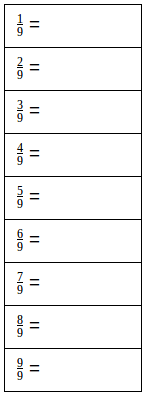
Today in class we were analyzing the pattern of ninths when converted to decimals.
Students had to write the decimal equivalents in the table and notice patterns.
It went according to plan.  Students write 9/9 as 1 but noticed the pattern of the numerator repeating in decimal form, which begs the question: is 9/9 or 1 equivalent to 0.9 repeating?

It's always a fun debate because the thought that it could be just blows their minds.  Thus setting the tone for 7th grade math where we take everything they think they know (rules and overgeneralization) and turn it upside down.  

Today's math debate however just blew my mind.  For those who have not been following my blog and tweets, I have been working with the ideas in Becoming the Math Teacher You Wish You'd Had by Tracy Zager.  Everything we do I put through the mathematician filter.  With that filter on, the debate was really a chance for us to question what we were seeing in this pattern and prove our conjecture (whichever side you were on).  

As usual, most kids were on the side of 9/9 is not equivalent to 0.9 repeating.  Student on both sides were giving their reasons for why they stood on that side of the room.  The patterns show they are equivalent on one side.  0.9 repeating is close to 1 but there is a number that we cannot name that would have to be added to get to 1 on the other side.  

Then one boy crossed the room, very nonchalantly while someone was talking.  The conversation went something like this:
Me: Tyler, I noticed you switched sides.  Do you want to talk to us about that?
Tyler: As I listened I realized that we didn't really have an argument that proved the other side wrong.


And that, my friends, is the difference between teaching students to explain/justify and having them prove.  In order to prove you are on the correct side of the room, you need to disprove the other side's thinking.


If you are interested in my other  Becoming the Math Teacher You Wish You'd Had blog posts you can find a complete list here.

Monday, September 11, 2017

Participating in a Twitter Chat

Twitter and Twitter chats have been transformational for me the past few years.  I want others to have the same amazing experiences that I have had.
I have many colleagues who have attempted to participate in Twitter chats and have felt overwhelmed.  I admit that depending on which chat you are joining some of them can be extremely overwhelming.  In an attempt to help my colleagues (and anyone else who may be reading this) feel less intimidated by the chats, I created some screencastify videos during one of my favorite chats, #msmathchat.

*Disclaimer: I did not script these videos (that will be clear when you watch them).  I thought about what should be included ahead of time, but I was also trying to participate in the chat which was more difficult than I thought.  Nonetheless, I think the videos will be helpful.

Preparing before the chat:
I like to have both Twitter and Tweetdeck open for chats.  This video explains more about my pre-chat rituals.


The start of the chat:
Chats typically start with introductions.  This helps you know who you are talking to.  If you find someone who teaches the same course as you it is a good person to follow on Twitter.


Participating in the chat:
Think of the chat as a social gathering.  They can range from small to extremely large gatherings.  It is not a whole group, wait your turn, type of discussion.  There are many side conversations.  You do not need to read everything that is a part of the chat.  You can jump into any side conversation at anytime.  Ask questions. Express agreement. Sometimes you will find that as you are typing someone posts exactly what you were thinking.  Don't let that stop you from posting.  It is ok to say the same thing.  That is what connects us as a group.

  • Always include the hashtag so others see your tweet.
  • Moderators will label questions with Q1, Q2, Q3...  You should label your responses A1, A2, A3...


Responding to Others

If you watched the video you understand the disclaimer above.  But here is the thing about about Twitter, blogging, and social media for teachers, if you wait until it's perfect it will never happen. It is an easy and informal way to share all of the great ideas and resources teachers have. No one is judging.

If you have any questions or there is something else you would like me to explain in a screencast, just use the comment section below to let me know.  I look forward to "seeing" you in a chat soon!

This site claims to have a complete list of Twitter chats for education.  I'm not sure if has them all but there is definitely something for everyone.


Sunday, September 10, 2017

Purposeful Popsicle Stick Picking

I am so excited about this idea.  Before I explain it let me give you a few background links.
After reading Tracy Zager's book Becoming the Math Teacher You Wish You'd Had I created these posters and hung them in my room.


On the wall before the posters it says Mathematicians... and then these are all in a line following that.  
Can you picture it? Great!

Then during the first week of school I asked students these questions about the posters and we used them to set goals.  

I have done goal setting in the past.  Not necessarily regularly because it is one of those things I'm bad about following through with.  The goal sheets get put to the side and at best I would pull them out later in the year and ask how we did with our goals.  I don't know why it hard for me to follow through with goal activities, but it might have something to do with the fact that the goals always seem to be grade oriented.  Meaning what students will do to get a good grade.  I am not a big fan of grades.  I get why we have them, but students (and parents and sometimes teachers) lose sight of learning.  It all becomes about the grade.  

I want this year to be different.  The goals were multiple choice.  9 choices that are all focused on what mathematicians do.  The students had choice in what they wanted to work on, and I only have 9 goals to focus my instruction around - not 26 or 80 personal goals to meet with students about.  This all kind of came about this week and I was loving it, but I didn't really have a next step.  Until this morning.  
Colored popsicle sticks.  How many teachers have those popsicle sticks with all the students names on them?  Before you call on a student you pick a name out of the popsicle stick cup. Sound familiar?  
It is so brilliantly simple.  I could not be more excited.  Here is what I have done:

Each student's popsicle stick is color-coded based on their goal!!!

Here are a few notes on the making of the sticks before I share my plan for them:
You can get colored popsicle sticks but I could only find 6 colors and I needed 9.  It is possible to dye them but I wanted to make sure the colors were different enough to tell them apart and was worried dye would not do that.  I simply took washable markers and colored the tips.  I tested colors until I found 9 that were different enough.  If you line up the sticks you can run the marker over multiple sticks at a time.  It did not take that long.  
For the most part the color on the popsicle stick matches the background paper of that poster.  Because I didn't know I was doing this there were some repeat background colors so the sticks don't match exactly.  If you decide to do this and don't have the posters yet I suggest a different background color for each so the sticks can match (ur maybe that is only important to me).  

Here is my plan for using them:
Just a heads up, this section is still just a big ol' brainstorm. I don't have my book with me. (Can you believe it?  How did that happen?) I plan to look through all of my highlighted goodness in the book, and I will update and add things as ideas come to me. I just want to jot down some starting ideas.

Whenever I pull a stick I can be purposeful in the language I choose to invite the student into the conversation:
  • Ted, why don't you take a risk and tell us about the strategy you used or where you got confused.
  • Jane, since you are working on proving (or reasoning) why don't you share your reasoning and we will be skeptics and help you see if we need to fine tune anything.
  • Seamus, where did your intuition tell you where to start and how did you verify if it was correct?
  • Livy, is there anything about this work that is troubling you? (I remember this question even without the book.  I loved it so much. It's a great question to get students questioning, especially after I make incorrect statements with confidence to push them to question me.)
  • Milo, let's put your work under the document camera.  We will give you feedback as to whether it is clear and makes sense to see how you are coming with your precision.
What I really like about some of these questions is that they not only help the student remember the goal they are working on, but now the class becomes supporters of that student and their goal.  We are all helping each other.  We aren't critiquing your reasoning because I understand it and you don't and now you feel like I am better than you.  We are a team and we want you to help you reach your goal just like you help us.  It feels different, even as I write the questions.

Of course, there are certain activities in my classroom that lend themselves nicely to focus on certain goals.  Not that I would only call on those that have that goal, but for those who tend to not participate or the sticks that are left in the cup, it is a good way to draw them in.  I was going to list some examples for you but I don't really have anything that isn't already in Tracy's book.  You can go back and look or buy it and read it for the first time.

Also if it is an activity I am using specifically to focus on one area, like connecting ideas or making mistakes (reflecting on what we can learn from them or why doesn't that work type of questions) I could use the sticks to create groups.  I would pull the names of the students who are working on that goal and they would each be in a separate group.  The the rest of the sticks I could pull randomly.  The people who are focusing on that goal could lead the discussion.  

Like I said, this is a brilliantly simple idea.  I am sure that your brain is already coming up with questions you would ask students or ways you would incorporate these sticks.   Go back to the chapter you are reading or your favorite chapter and think about these sticks as you read.  I want to know all your thoughts and ideas.  Please use the comment section below to share.  I am so excited to see what we create together.  


If you are interested in my other  Becoming the Math Teacher You Wish You'd Had blog posts you can find a complete list here.